|
Mold Inspections on Marco Island
Marco Island consumers should understand that our mold assessment (inspection) reports meet and exceed the requirements of Florida Mold Statutes. Many inspector reports don't. Mold Inspection Reports should identify the source of the mold problem, the location and extent of mold problem and include recommendations for the mold cleanup (protocols). Mold inspection reports should be required to include 'post remediation requirements' (clearance/what needs to be done to prove mold cleanup was successful).
Please contact our office to schedule:
Radon Tests / Mold Assessments (inspections) & Sampling
Formaldehyde & VOC Tests / Allergen Screening
Radon & Mold Professionals Toll free: (800) 881-3837
188 1st Street, Bonita springs, FL 34134 .... (239) 498-4619
188 1st Street, Bonita Springs, FL 34134 .... (239) 948-9717
radonandmoldprofessionals@gmail.com
or radonandmoldprofessionals@comcast.net
Easy to understand as well as detailed mold assessment (inspection) report provides the remediation company the information needed to give the Marco island client a proposal for cleanup.
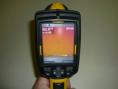
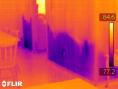
| Infrared image showns moisture on drywall |
|
| Moisture is always confirmed with moisture meter |
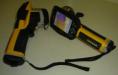
Infrared themal imaging cameras are used by all Professional Marco Island Mold Assessors (inspectors).
Large areas can be checked quickly and hard to access areas such as ceilings can easily be checked.
| digital photo of area in photo on the left |

|
| Mold need moisture to grow (food & water) |
Your Marco Island Mold Report should always include digital photos of areas of concern to aid client in locating them after inspection.
Your Marco Island mold inspector (assessor) must be licensed as such by the state of Florida. Professional mold inspectors will always use an infrared camera to scan large areas of your home or office for possible moisture intrusion which can result in mold growth. Any suspect areas identified with an infrared camera must also be checked with a moisture meter.
Mold Assessment
Mold assessment report is a document prepared by a Florida DBPR licensed
mold assessor for a client. The mold report describes any observations made,
measurements taken (samples), and locations and analytical results of samples
taken by the assessor during a mold inspection. An assessment report can
be either a stand‐alone document or a part of a mold management plan
or mold remediation protocol or mold remediation recommendations prepared by the mold assessor.
Air Sampling only: 'Mold Air Sampling only' is often used to help determine the extent of a mold problem and/or to help "clear" a Marco Island mold remediation project.
Air sampling protocols (minimum)recommend an air sample be collected by the main return area of each HVAC system. If home is a 2 story structure, an air sample is recommended on each floor.
·An outdoor sample (baseline sample) is also required.
·Minimum air sampling (mold testing) is one sample outdoors and one sample indoors.
·For insurance claims a surface sample of any visible mold is generally required (tape lift or swab).
Mold Assessment (Inspection / Air Samples/ Recommendations):
We use Infrared cameras, moisture meters, etc. We provide source identification, documentation of extent and amplification of mold, photo documentation with recommendations for corrections based on national guides such as S500 & S520 for the accessible indoor living space.
(Assessment = visual inspection & air sampling for accessible indoor space)
What You Need to Know About a Marco Island Mold Assessment
The purpose of a visual assessment for mold is to identify and document the following criteria:
1) the location(s) of interior substrates and/or contents displaying visible mold growth;
2) conditions actively conducive to mold growth (i.e. wet building materials, high humidity, HVAC problems, etc.);
3) conditions previously conducive to mold growth (i.e. water damaged materials that are currently dry);
4) the potential source(s) of moisture that are deemed responsible for creating the identified problem(s); and
5) determine the indoor air quality as it specifically relates to aerosolized mold spore concentrations (i.e. consistency with normal fungal ecology).
Air sampling only for mold (which is commonly performed with a 'home inspection') should not be relied upon as a conclusive determination about a given property's mold condition. Air sample analysis is useful and valuable information however it does have significant limitations. For instance, air sampling data will not identify the 'source' location(s) and all too often can show a non-elevated airborne condition (i.e. passing air samples) even though a mold problem exists within the home.
The above criteria are not typically included with a general 'home inspection' that is primarily designed to identify 'functionality' issues (i.e. what works and what doesn't work) of a given home. All too often, we receive air sample reports showing elevated airborne concentrations yet the inspector doesn't identify the actual source of the problem and defers them to a remediator. Unfortunately with this scenario, the remediation company doesn't know the source either and there ends up being more questions than answers. Conversely, we have seen countless passing air samples yet a mold problem is found after the fact.
At the end of the day, do not rely on air samples only or air samples performed with a 'home inspection' to give you a conclusive perspective of the property's mold condition. If mold is a concern, have a mold assessment and not just air samples. It will save a lot of time and money to do it right from the start.
Our Florida mold inspections are designed to provide a thorough assessment of the home or business for the presence of mold, conditions conducive to mold growth and for determining the indoor air quality. We accomplish this by providing a thorough visual inspection of the indoor environment and the collection of air and or surface samples. Samples are collected following Indoor Environmental Standards Orginization (IESO) protocols and shipped overnight to a third party, AIHA (American Industrial Hygiene Association) EMLAP (Environmental Microbiology Laboratory Accreditation Program ) accredited laboratory for environmental microbiology analyses.
Indoors mold can only grow if two conditions are present: first is an organic food source and the second is sufficient moisture. Food sources for mold indoors are abundant. They include building materials like drywall, pressboard materials, cabinetry and settled out airborne particulate like dust. Because these food sources are inherent in most every building, controlling the food sources is not realsitic. The other necessity for mold, sufficient moisture, is the controlable factor. The truth is, if you control moisture indoors, you will never have a mold problem.
Utilizing infrared thermal imaging cameras on every inspection helps us identify areas that are wet and actively evaporating moisture. A roof leak, for instance, that is impacting the living room ceiling may not be obvious to the naked eye, however when that area is viewed with the infrared camera, the wet (cooler) area of the ceiling will show clear as day. In addition, we also use an instrument called a protimeter. This device is placed directly on a given surface like a wall or the interior of a sink base cabinet which then provides a readout of the relative moisture content of that material. For instance an area of drywall under a window that is getting wet as a result of water migrating in through cracks in the exterior stucco and or under the exterior window frame, will show a much higher moisture content than the the dry, or normal moisture content, of the drywall to the left or right of the window.
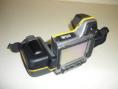
| John prefers this camera for Mold Assessments |
|
|
| FLIR Infrared Thermal Imaging Camera |
| All of our Mold Assessors use Infrared Cameras |
|
|
| This "tool" is always confirmed with moisture meter |
| Infrared cameras allow us to scan large areas |
|
|
| Mold needs Moisture to Grow |
Another moisture source that negatively impacts many of the homes, from a mold perspective in Florida, is the indoor humidity levels. This moisture source is less understood in respect to its impact on the indoor environment. Too often as well, it is poorly understood the critical role the HVAC system (Heating, Ventillation and Air Conditioning) has on the indoor relative humidity and indoor air quality as a whole. When a properly maintained and operating residential A/C is running, it obviously is providing cooler air to the indoor space. However, and far less understood is, it is also removing moisture from the air. Residential HVAC design cools/heats the same indoor air over and over. For air conditioning, the HVAC system pulls the air in the home into the system at the main return(s), cools it down and then supplies it back to all rooms in the home designed to be under air. In the process of cooling the air down, it drops the air temperature to below the dew point temperature. When this happens, water vapor in that air is condensed into liquid water. Those white PVC pipes we often see sticking out of the exterior base of a home that are dripping water, that's the water that was just in your home's air in the form of water vapor, commonly known as humidity. When the HVAC system is not operating properly, oversized, turned off completely or has the thermostat set too high, it loses the ability to remove that water vapor from the indoor air. As a result, indoor humidity levels increase. Generally speaking, humidity levels consistently above 55% indoors provides sufficient moisture for many molds to grow. This fact leads to the importance of the visual inspection part of our asseement. All too often, a home can look just fine as you walk around, upon closer inspection however, humidity driven mold growth can be growing on numerous surfaces throughout. Interior sides of closet doors, the undersides of shelving, cabinets, tables and chairs are typical locations. In this all too common scenario, the mold is utilizing the available moisture in the air (elevated indoor relative humidity) and settled out organic airborne particulate and/or organic building materials for food.
| Particle counters are also handy tools |
|
|
| Tracking down the source of mold is often difficult |
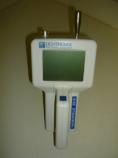
Particle Counters help your mold assessor by measuring the particles (mold spores) in the air in a given location. In many cases, the closer to the source, the higher the count. Particle counters are expensive but very useful tools for the professional mold inspector. Mold remediators often hire us to check their air scrubbers for leaks; a leak allows mold spores to by pass the filters designed to remove air borne particles. The goal during mold remediation is to remove mold spores from the air with air scubbers. This sometimes happens when a new filter is not installed properly or is sized wrong.
As Board Certified Indoor Environmentalists (CIE) by the American Council for Accredited Certification and having performed well over 8,000 mold inspections in Florida since 2002, our hands-on field experience and technologically advanced tools, helps each of our clients receive a professional, comprehensive and well documented assessment of mold and moisture inside their home or business. It is also critically important to realize that we, as a company, do not provide any remedial services. Put simply, we don't fix anything. As a result, we do not have any vested interest in the outcome of our assessment. No financial gain interests or concerns, no financial losses interest or concerns. Our # 1 job when in your home or business is to document our findings and provide you a comprehensive report.
|
Certified Indoor Environmentalists licensed as Mold Assessors by the state of Florida are the first choice of professional home inspectors for their clients environmental concerns such as mold. CIE's have to prove experience and pass one of the exams now adopted by Florida for a mold license. Most mold assessors were "grandfathered" in the mold license and did not pass an ACAC exam.
|
|